















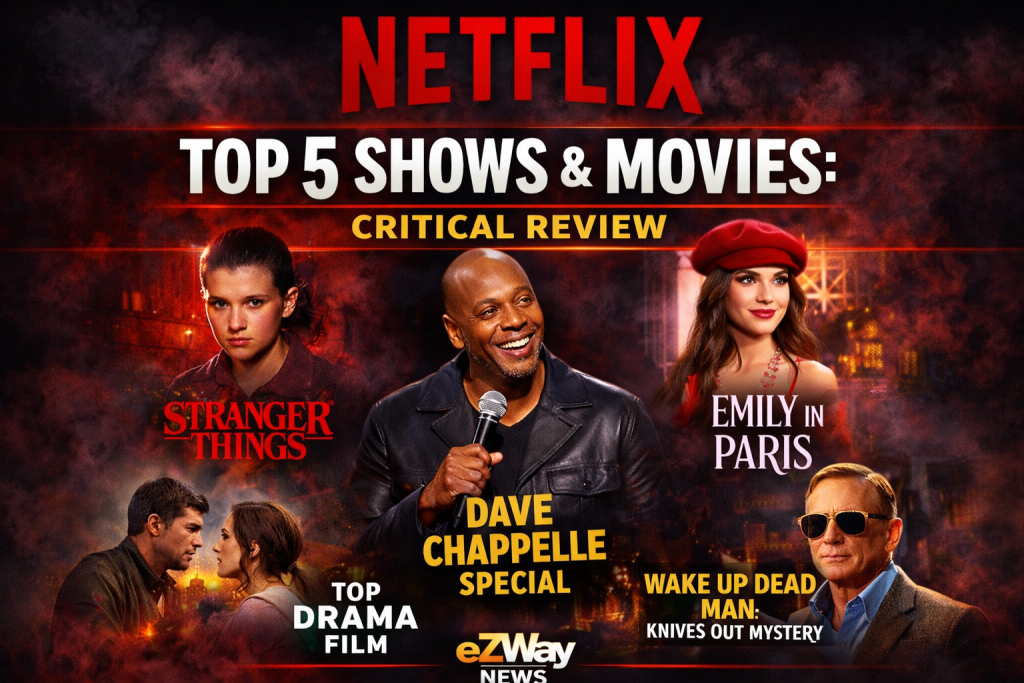
What Viewers Can’t Stop Watching: A Critical Review of Netflix’s Top 5 Shows & Movies
By eZWay News – Entertainment Desk
As streaming competition intensifies, Netflix continues to dominate the cultural conversation by blending spectacle, star power, and algorithm-driven programming choices. This week’s Top 5 most-watched shows and movies reflect not just popularity, but the evolving tastes of a global audience seeking familiarity, commentary, and cinematic escape.
Below is a journalistic, critical overview of the titles currently driving viewership — examining not only what audiences are watching, but why these projects resonate.
1. Stranger Things
Genre: Sci-Fi / Drama
Verdict: ★★★★½
Few series have achieved what Stranger Things has: a rare blend of nostalgic reverence and modern spectacle. Its continued dominance in Netflix’s charts underscores the enduring power of franchise storytelling done right.
From a critical standpoint, the show succeeds because it balances emotional intimacy with blockbuster ambition. While its later arcs lean heavily into cinematic excess, the core strength remains its character-driven storytelling. The series is less about monsters from another dimension and more about the human cost of growing up, loss, and loyalty.
Journalistic take: Stranger Things isn’t just popular — it’s institutional. Netflix has effectively turned the series into a cultural anchor, one that keeps subscribers emotionally invested long after first release.
2. Emily in Paris
Genre: Romantic Comedy / Lifestyle
Verdict: ★★★½
Often polarizing among critics, Emily in Paris thrives precisely because it knows what it is — and refuses to apologize for it. Beneath the fashion montages and postcard Parisian visuals lies a calculated escapist formula that performs exceptionally well in a fatigued media landscape.
Critically, the show lacks depth in its cultural exploration, but it compensates with pace, charm, and visual branding. Netflix understands the value of comfort television, and Emily in Paris is engineered for repeat viewing and social media virality.
Journalistic take: This series isn’t trying to be prestige television — it’s lifestyle entertainment, and it succeeds by design.
3. Dave Chappelle Netflix Special
Genre: Stand-Up / Social Commentary
Verdict: ★★★★☆
Dave Chappelle’s latest Netflix special continues his role as both entertainer and provocateur. Unlike traditional stand-up releases, this special functions more like an op-ed — blunt, confrontational, and intentionally divisive.
From a critical lens, Chappelle’s delivery remains masterful, even as the material increasingly prioritizes commentary over laughter. Netflix’s platforming of such content highlights its willingness to host cultural debate rather than shy away from controversy.
Journalistic take: Whether applauded or criticized, Chappelle’s specials generate conversation — and in today’s attention economy, discourse is currency.
4. Netflix Original Drama Film
Genre: Drama / Thriller
Verdict: ★★★★
Netflix’s latest high-performing drama film exemplifies the streamer’s evolving film strategy: emotionally grounded stories paired with cinematic production value. These films often lack theatrical release but perform strongly due to accessibility and algorithmic promotion.
Critically, the film succeeds through pacing and character focus rather than spectacle alone. It reflects Netflix’s continued push toward prestige-leaning originals that blur the line between festival cinema and mass-market entertainment.
Journalistic take: Netflix’s strength lies in volume paired with competence — films like this reinforce the platform’s role as a primary destination, not a secondary option.
5. Wake Up Dead Man: A Knives Out Mystery
Genre: Mystery / Crime
Verdict: ★★★★½
The Knives Out franchise remains one of Netflix’s most successful acquisitions, and Wake Up Dead Man continues the tradition of clever plotting and ensemble storytelling. Anchored by Daniel Craig’s now-iconic detective Benoit Blanc, the film balances wit with genuine intrigue.
Critically, the franchise’s greatest strength is restraint — it avoids over-serialization, allowing each installment to stand alone. The result is a mystery that feels fresh while honoring classic whodunit conventions.
Journalistic take: In an era of endless sequels, Knives Out works because it evolves without exhausting its premise.